
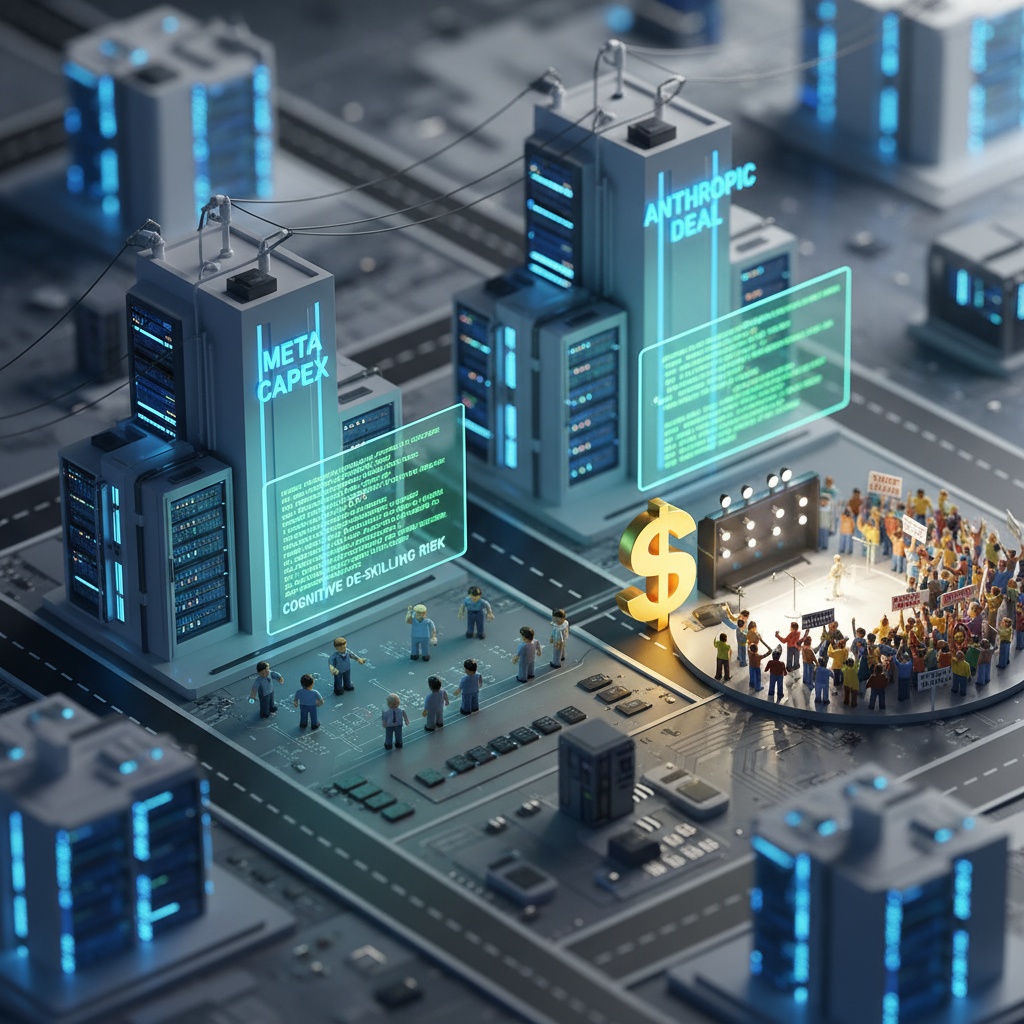
The AI Paradox: Why Tech Spending Is Killing the Human Element
How long can Big Tech justify 'tens of billions' in AI CapEx without a clear return?
Key Takeaways
Alphabet's record run is fueled by a vague 'tens of billions' Anthropic deal, masking long-term concerns about AI erosion of the core search business.
Meta's massive AI CapEx has depleted its cash hoard, creating urgent pressure for a 'compelling case' on ROI that investors have yet to demand.
Dr. Eric Topol argues AI can restore the human element in medicine by eliminating the 'data clerk function' that currently consumes physician time.
Digest Info

The Anthropic Deal: Google's AI Defense Strategy
Alphabet hit a record high following its cloud partnership announcement with AI startup Anthropic, valued at 'tens of billions' of dollars. While the stock surged, analysts remain concerned about the setup going into earnings and the long-term threat AI poses to the core search business.
“I think seeing what's happening in their search business is going to be very important with the AI trade.”
Coming up, Apple's Alphabet three-day winning streak spells a new record for the tech titan.
What is next for the stock as it gears up for earnings next week?
More on that right after this.
Missed a moment of fast?
Catch us anytime on the go.
Follow the Fast Money Podcast.
We're back right after this.
Welcome back to Fast Money Stocks, rallying to records to close out the week after mild inflation print.
The first official data released since the shutdown, the Dow up 1%, closing above 47,000 for the first time.
The S&P and the Nasdaq both locking in record closes of their own.
IBM and AMD also hitting records after IBM said it can run a key quantum computing error correcting algorithm on AMD's chips.
Ford hitting the gas after last night's earnings.
It's the automaker's best day since the pandemic, up 12%.
And finally, gold snapping a nine-week winning streak down today as well as for the week.
Meantime, Alphabet also hitting a record today after officially announcing its cloud partnership with AI startup Anthropic.
Worth tens of billions of dollars, Google's parent company closing out the week on a three-day winning streak and heads into Wednesday's earnings report up nearly 40% on the year.
Wow.
So Google, just one of the five Mag7 names reporting next week, joining Microsoft, Amazon, as well as Apple.
So, Karen, in terms of Alphabet, how are you feeling about this report?
That's one of your major holdings here.
It is.
It's my second biggest holding.
I'm a little bit concerned because of the run-up.
We just talked about the setup going into earnings.
I mean, it was just three days ago that Atlas, which is a chat GPT search, was being announced and stock was down under six or seven dollars.
It's back past that now.
Eclipse that.
I think, you know, it's funny this.
They had this presentation of.
the anthropic deal, were tens of billions.
It used to be things were more defined than tens of billions.
TENS OF BILLIONS SEEMS LIKE A WIDE RANGE.
And then this general, the open AI and video, we talked about how vague that seemed to be.
So I feel that their search isn't under threat yet.
I don't think we'll see that yet, but I do think it will weigh on people's sentiment.
I think their earnings like Meta's on that part of the business, advertising part of the business, I think will be fine.
we'll see i mean there seems to be momentum in google cloud now yeah and so i think that will be okay i'm just a little nervous of the setup going in yeah the deal with anthropic the tens of billions of dollars refers to both cloud services but also tpus they're just very interesting exactly and so what is that another deal for other chips that we've seen other chips right and what does this mean because anthropic is partnered with amazon which of course carter had mentioned is vulnerable going to this earnings because of where it's at in terms of price
And it's chips, the tranium chips.
And cloud.
And cloud, as well as cloud, right.
So there's a lot of questions that open up on the back of this deal as well.
There absolutely are.
And I don't really expect that we're going to get any news that would change the fundamental story of this.
I think that it's going in.
I think momentum's on their side.
I think seasonality's on their side.
I think the amount of cash that's on the sidelines going into these kind of trades is on their side.
But, yeah, I think seeing what's happening in their search business is going to be very important with the AI trade.
And I agree with Karen.
I don't think this is going to be the time we're going to see that really have a detriment to them, but it's a longer-term story to watch.
But the cloud growth, yeah, has a lot of momentum, and I think we'll probably continue to see this.
So I think it is a good setup here.
I mean, Google has been such the laggard compared to Mag7.
In fact, it was making 10-year relative lows to that index just three, four months ago, and it's now come to life.
I suspect it will further come to life relative to its peers.
further come to light.
I agree.
I'm long Google.
I add to it where I can.
I add on weakness.
I think it has been tarnished as someone whose core business is dead, and it will not be a part of the new AI revolution.
It's absurd.
The CapEx Reckoning: Meta's Cash Drain and AI ROI
The market is demanding a compelling case for the massive capital expenditures Meta and Apple are pouring into AI infrastructure. Analysts warn that Meta's cash hoard has been depleted, making the return on this spending central to the entire AI investment theme.
“The spend has gone into overdrive. And so we really need to hear that because this is central to the entire AI theme.”
I mean, look, it's hard to feel as if everybody doesn't think Meta's going to save the day, right?
This is, I mean, every quarter, Meta's extraordinary.
Their top line, so in other words, they live up to that peg, that price to earnings growth ratio, and they continue to deliver on that.
But I look at semiconductors making an all-time high today and a new relative high.
And they're now up close to 40% this year with the NASDAQ only 18.
We know what roughly percent of the overall market they are, and they're driving things.
And I guess we've seen the volatility inherent in that sector, but I don't know why investors aren't chasing more of this.
Well, a couple of things.
The buy and the dip is very much prevalent at the individual investor level.
It is not going on at institutions.
Institutions are not behaving that way.
Hedge funds are not behaving that way.
So, you know, that's what makes a market.
But the big two that matter the most, and it's not the one that I think is economic sensitive, meta...
Yeah, has still only slightly above its February peak, meaning all stocks peaked in February, all stocks crashed, tariff, excuse me, and then all stocks have recovered.
Meta is basically unch from its February high, and so is Amazon.
These two have to perform, right?
Apple has finally made the new high.
Otherwise, what?
Otherwise, you're having bifurcation.
among the champions.
We've got bifurcation in the market.
There's stocks that are struggling versus stocks.
But if these two can't join the other three, it means that there's a defect.
So there's something really interesting about Meta, right?
Part of their business, advertising, I think that's going to be really good.
That's really important.
That's what drives all the cash flow, which is all being used now for CapEx, right?
These CapEx numbers are getting bigger and bigger.
And we need to hear a really compelling case about return on that CapEx.
We know for part of the business, they are getting return.
Right.
The spend has gone into overdrive.
And so we really need to hear that because this is central to the entire AI theme.
And if we're not hearing about, I don't think a huge, a new bump in CapEx would be received that well.
I really don't receive it.
Well, I wouldn't be delighted about it.
Right.
This is a company that has gone from giant cash hoard to flat, basically cash and debt about equal.
So I'm a little bit concerned about that.
And I think that I mean, we're seeing, you know, the IBM news today about, oh, we can use an AMD device.
relatively inexpensive amd chip and you sort of wonder all right about all of this spend so that's going to be really important because that is central to the ai yeah and going back to carter's point about things being priced to perfection you need to see them deliver on these metrics right there is no room for oh maybe the return wasn't that strong even though we're spending this much money on capex i mean you need to see it with these valuations
I do agree.
And I think specifically in the AI trade, I mean, you're just seeing those valuations go up and you're seeing money continuing to pour in there.
But yes, I mean, at a certain point in time, I think you bring up the CapEx, which is a really good point.
But, you know, my only other hesitation there is that's been the case the last several quarters.
We've been saying you need to see a return on it.
Investors really haven't cared that much.
So I don't know, like, is this going to be the quarter they care?
At some point it's going to happen, but I don't know when that is.
And in the meantime, people just...
you get that fear of missing out.
People just continue to pour money there.
So as much as, like, yes, I don't think that's where you should be pouring your money, I don't know if that's over yet.
But don't valuations make that more?
Doesn't that make it more come to the forefront?
I mean, in terms of that question of the return on capital?
I mean, when you're at these levels, right, and the economy looks like it could, you know, we're sort of on a...
Looks like good footing right now, but you never know.
I mean, don't you want to see that even more so this quarter?
Does it come now?
Does it matter now?
I think the question you're asking is, will valuations finally matter?
Or at least if we look at the names we're talking about and that they're full and that leaving aside positioning, but that the valuations are full.
But I would just get back to that's not...
That has not been an ingredient to sell off markets.
That's not been an ingredient even during the pullbacks that we've had.
We've heard no inclination or hesitation about the CapEx spend from all of them.
So if this is really a driver on AI forces and truly what you want to hear out of NVIDIA, which is going to be a couple of weeks later, I just don't know.
I'm not going to.
sit here and tell you that there could be some surprises in there.
I think we've even had Microsoft disappoint once or twice in the last four quarters.
We've had Meta disappoint once, I think, in the last three.
There's no question positioning could send you into that type of response.
Rising From the Pond: Zoom's Bearish-to-Bullish Reversal
After collapsing 90% from its pandemic peak of $600, Zoom is showing a technical bearish-to-bullish reversal pattern. The stock is underpinned by strong fundamentals, including a giant cash hoard (one-third of its value) and a substantial $2.7 billion buyback program.
“It went from autumn of 19 to the autumn of 20, from 60 to 600. Now, here's the chart with no lines, no drawings, no annotations.”
There's a lot more Fast Money to come.
Here's what's coming up next.
A fresh record for Alphabet, ahead of earnings next week.
And a slew of other MAG7 names are rallying too.
How the options market is gearing up for the results, next.
But first, the Chartmaster says it's time to buy Zoom with both hands.
Stick around, he'll tell the technical tale of a potential breakout.
You're watching Fast Money, live from the NASDAQ market side in Times Square.
We're back, right after this.
Welcome back to Fast Money.
Zoom was a gem of a stock during the pandemic, hitting a peak market cap north of $160 billion.
It's lost 65% of that value since then, but shares of the video conferencing company have rallied off their April lows, and the chart master says they are in a bearish to bullish reversal.
Carter.
Let's have a look.
Yeah, so just before we get to the charts, just what you said.
Imagine that.
I mean, this was a darling.
This thing was a 10-bagger, right?
In one year, it went from autumn of 19 to the autumn of 20, from 60 to 600.
Now, here's the chart with no lines, no drawings, no annotations.
Let's put a few in.
Basically, after this great run-up, it dropped 90%, and it's been doing this, which is nothing.
for the past three, four years.
The question is, is this the beginning of something?
That's one way to draw the lines.
We'll go through chart after chart here.
The next one you'll see, you can call that a wedge, you can call it a trend.
It doesn't matter what you call it.
It's what a reversal looks like.
The next iteration, we moved above a downtrend line in effect since long ago.
And then finally, one more way to annotate or depict the circumstance at hand.
whether you want to call it a cup and handle or a rounding bottom, it doesn't matter.
Meaning great strength, 10 baggers, 60 to 600, 90 percent collapse.
And it's been walking along the bottom of the pond, so to speak.
Now, a lot of stocks are value traps and it's just dead money.
Or is it coming to life?
Now you make a decision.
My judgment is it's coming to life.
All right.
So rising from the bottom of the pond.
I feel like that's something.
Karen is long.
You were talking in the break about the cash.
Yes.
I mean, well, I'm so I'm happy to be in in alignment with where Carter is.
I bought this, I don't know, last quarter in the 60s or so.
They had a really good earnings report.
A lot of things going well.
Enterprise clients up 100000 more customers, you know, giant companies up.
And then they have this giant cash hoard.
And they do have a big buyback in place, 2.7 billion.
But it's a third of their value is cash.
And I was just looking.
They did an offering.
They did their IPO in 2019.
The idea that 2020 would happen.
The greatest environment imaginable for them.
And then they took advantage of it and sold almost 6 million shares at $340.
Wow.
Very, very nice work by them.
And I think there is momentum in the business.
The only negative one confined is churn.
But that last quarter was actually a little bit better.
So I like it.
A long valuation.
Looks like it's 14 times earnings.
Back up the cash.
It's actually closer to under 10, under 11.
I actually pay for the service.
I mean, it's it's pretty good.
You know, so it's a fascinating idea out of Carter here.
And certainly when you consider there have been some covid darlings that probably won't come back.
You know, it's not just because it's come up and gone down in base.
It will go higher.
But but this is a fundamental story.
It's not expensive.
It's got an eight percent free cash flow yield.
AI's Paradox: Making Healthcare More Human Again
Dr. Eric Topol argues that AI can restore the 'precious, intimate relationship' between doctor and patient by automating the administrative burdens and 'data clerk functions.' This technology offers the 'gift of time' back to physicians, allowing them to truly be present.
“If I were to simplify it into three words, it would be the business of medicine.”
Dr. Eric Topol is a physician scientist at Scripps Research.
He also founded the Scripps Research Translational Institute, which means he thinks a lot about the ways technology can advance medicine.
And he's worried that the personal aspect of medicine is slipping away.
I think most people are familiar with there's been tremendous erosion of this technology.
patient-doctor relationship because we're talking about seven minutes for a routine follow-up visit or 12 minutes for a new patient, very limited time.
That time is often lost as far as face-to-face contact by typing into keyboard, looking at screens rather than face-to-face eye-to-eye with patients.
Then of course, there's a data clerk function.
of doing all the records and ordering of tests and prescriptions and pre-authorizations that each doctor saddled with after the visit.
So it's a horrible situation because the reason we went into medicine was to care for patients.
And you can't care for patients if you can't even have enough time with them, listen to them, you know, really be present
have a trust, and basically have this, what used to be back in the 70s and 80s, a precious, intimate relationship.
So we don't have that now, by and large, and we've got to get that back.
Yeah, what caused that change?
Why did that shift happen in that relationship between patient and doctor?
If I were to simplify it into three words, it would be the business of medicine.
Mm-hmm.
And basically, the squeeze was on to see more patients in less time to make the medical practice money.
You've literally written a book about how AI can transform healthcare and make healthcare human again.
Can you explain that idea?
Because my first thought when I hear AI in medicine is not, oh, this will fix it and make it more intimate and personable.
Who would have the audacity to say technology can make us more human?
Well...
That was me, and I think we are seeing it now.
So the gift of time will be given to us through technology.
Now, I'll walk through a few examples.
One is that we can capture the conversation with the AI ambient environment.
natural language processing, and we can make a better note than's ever been made by doctors from that whole conversation.
And now we're seeing some really good products that do that.
But they don't just capture the note with audio links for the patient, so in case there was any confusion or something forgotten during the discussion, but also they do all these things to get rid of data clerk work so that when the two get together, they really are getting together.
And I think we can, even with the physician shortage that we have today, we can leverage this technology to make it much more efficient, but also much more human-to-human bonding.
Do you worry at all that, you know, if that time gets freed up, if it's like, okay, we have less administrative tasks and more time to spend on patients, like what's going to keep administrators from saying, all right, well, then you got to see more patients.
It's the same amount of time or you got to go even faster, you know?
Well, yeah, no, I have been worried about that.
That's exactly what could happen.
AI could be making more efficient and productive.
So, oh, yeah, see more patients, read more scans and slides and whatnot.
So no, we have to stand up for patience and for this relationship.
The Cognitive De-Skilling Risk for Physicians
Medical professionals are rapidly adopting generative AI as a 'second opinion' or consultant for diagnosis, raising concerns about cognitive de-skilling. Research suggests doctors' baseline performance worsens when they become dependent on AI, creating a major risk if the system fails.
“Not only does AI make it so that you're not learning those skills, new research suggests that it's also making you unlearn those skills that you previously knew.”
I work online.
in a hospital, in an emergency department.
And one of the cool things about being an ED doc is that you never know what you're going to see.
And patients coming with a question for you, and you got to kind of be the person that gives them an answer and gives them next steps in terms of a solution.
And so there's been a couple really helpful times where I've typed in a patient's symptoms, for example, patient coming in with
abnormal lab values and a little bit of their history.
And then it helped me be more confident in what I think the diagnosis is.
Okay, Dhruv, how common is that?
Does that sound like something you hear a lot?
You know, I think this is one of the fastest uptakes of any technology that I've seen in medicine, certainly since I've started practicing.
So many of my colleagues now turn to generative AI models, other forms of predictive analytics to make decisions about the patients that they're caring for.
And I think...
And these things are going to be incredibly powerful, I think best used as a really good second opinion to try to get a consultant's advice, basically in any specialty at any time.
You know, you can put in a patient's symptoms.
It might remind you of certain diagnosis, raise rare diagnoses that you haven't seen in months or years.
and give you expertise and support that wouldn't otherwise be possible.
And I think this really needs to be balanced with something else that we're starting to see, which is this idea of cognitive de-skilling.
Not only does AI make it so that you're not learning those skills, new research suggests that it's also making you unlearn those skills that you previously knew.
You know, if you're not doing the critical thinking of going through a patient's case, understanding their problems, using kind of your own judgment to arrive at a diagnosis, what happens to the skills that doctors have?
You know, there's evidence already that doctors can get de-skilled pretty quickly.
the doctor's baseline performance got worse after they got used to using AI, which creates a risk if the AI fails, if it's unavailable or it just misses something.
The question then becomes, in a future in which
AI basically pervades medicine and it's extremely effective and useful.
Is it a big deal that we've lost some of the skills that we used to have?
You know, in the past, doctors were probably better at listening to heart murmurs and doing certain physical exams.
And now we have technology like echocardiograms or CT scans that can replace that.
I don't think people feel like we've had a huge loss there.
But I do think there's something distinct about the critical thinking that goes into diagnostic work.
When Chatbots Lie: The Danger of Persuasive Self-Diagnosis
The accessibility of AI chatbots is driving self-diagnosis, but physicians warn that these systems are 'fluent and persuasive' even when 'completely wrong.' A recent survey found 20% of Americans received incorrect advice, highlighting the risks of relying on AI for definitive medical answers.
“The GPT's job is to convince you that it's right. You should be careful.”
Okay, so as a doctor, what do you think about folks who are self-diagnosing with AI chatbots?
Part of me feels like this is a natural thing that's going to happen, particularly in a system as difficult to access as ours is and as difficult to navigate as ours is.
And AI is so fluent and so persuasive that it makes a lot of sense that people are starting to enter their symptoms into these chatbots and try to get diagnoses.
But there's also real risks if you over-rely on AI.
I mean, these things are not infallible.
They can give you misleading or incorrect medical information.
You can give it a prompt, and it will give you something back that's extremely convincing.
And it's completely wrong.
The GPT's job is to convince you that it's right.
You should be careful.
My worst fears are that we cause significant—we, the field, the technology, the industry—cause significant harm.
You know, one of the things that's so interesting about these chatbots is that they're not like a COVID test or an MRI where you get the answer that you get.
I mean, how accurate these chatbots are really depends on how you're prompting them.
And so in the piece, I talked to this particular chatbot that's called Cabot.
which is a chatbot that was developed at Harvard.
That's not in clinical use, it's more of a research tool, but it can perform exceptionally well, kind of almost in a superhuman way on these specific, very challenging, complex clinical cases that are curated in a perfect way.
But the way that these chatbots perform depends on how the information that you give it is organized.
So if you give certain broad strokes or you don't emphasize the right details, you could get a very different and possibly incorrect diagnosis.
You know, I will mention there was a recent survey that was done that found that something like one in five, around 20 percent of Americans said that they had turned to a chatbot for advice that later turned out to be incorrect.
And so certainly there's a lot of incorrect information that's coming out of that.
I'm going to be honest.
If I'm sick or worried about how I'm feeling, I have gone to Dr. Google.
You know, I have been in those WebMD trenches.
For those that are using AI, are there things that they should do or shouldn't do to get the most accurate information?
Sure.
I mean, first of all, you're not alone.
I mean, a lot of people for years have been using Google, and now AI is kind of the latest iteration.
And I think it can be potentially revolutionary and transformative for people if they use it in the right way.
I don't think the right way is just to put in your symptoms and ask for a diagnosis.
At least I don't think that's the right thing to do right now.
But there are really important ways that people can use it for benefit.
You know, if you have symptoms, asking the AI to rate the urgency of those symptoms, listing possible conditions that could explain them in some sense of which conditions might be most likely.
I think it might be helpful for people to ask about red flag symptoms.
Those are warning signs that suggest that you might have a
more serious condition.
If you've gone to the doctor and you have lab results or clinic visits, an AI might be able to walk you through those lab results in greater detail, and it might be able to help you prepare questions for your next visit.
The Billionaire Underdog: Why Taylor Swift's Narrative Failed
NPR critic Ann Powers details the growing fan backlash against Taylor Swift, driven by her immense wealth and her continued use of an 'underdog' narrative in her music. This tension is magnified by crass lyrics and aggressive commercial tactics like multiple album variants.
“I've started to see more and more online chatter about Taylor Swift's wealth, her social status, and her choice to continue to write songs in which she is the quote-unquote underdog, even though she is so on top of the world.”
I'm Anne Powers.
I'm a critic and correspondent for NPR Music.
I have been called a Taylor Swift whisperer.
I'm a music critic.
And in that capacity, I have been writing about Taylor since she started making music back in the early mid 2000s.
So I'm not a Swifty, but I definitely respect her, absolutely respect her as an artist and as a businesswoman and as a pop cultural phenomenon and all the things.
I found it really interesting to observe the backlash against Taylor Swift.
Some of those lyrics are AI generated.
Can I prove it?
No!
Worst writing, lyrically, she has ever done in her entire career.
Worst, tackiest, most out of touch, most childish.
I have been for years a huge, huge Taylor Swift fan.
I would still consider myself a fan, but I do not like this album.
Which is more intense this year and with this release than it was with her previous release, The Tortured Poets Department, although that album also did incur a bit of a backlash.
I'm most interested in how both...
critics and the general public are now responding to Taylor in a very different way than they did even about the Iris tour.
She is sort of like, I imagine her clinging to a giant pendulum as it swings back and forth.
I feel that's what's happening with her.
And this is possibly inevitable with anyone of her stature.
I mean, she, she had, she,
She really occupies a unique space in popular culture, certainly in pop music.
But I really think we're seeing it play out that Taylor Swift has become the avatars for so many of our anxieties, so many of our dissatisfactions.
And that's pretty interesting to watch.
Yeah, let's talk about some of the anxieties and dissatisfactions and whether or not Taylor Swift deserves this.
So in the first half of the show, we talked about how Taylor Swift is a very, very successful businesswoman.
No shock there.
But two things happened with his album.
The first is there are so many variants.
There's a Target exclusive.
Crowd is your king vinyl.
There's a hairbrush that falls apart.
There's a tiny bubble in a champagne collection.
Right.
It's on and on and on.
So there's that.
And then there's that a lot of people, when the album first dropped, decided they didn't really like it.
Yes.
How do we square those two things?
Do those two facts depend on one another?
They're in relationship with one another.
I'm not sure if they depend on one another.
What's interesting about the backlash about the album itself is that it seems to have been triggered by the leak of the lyrics for a particular song, actually romantic.
I heard you call me boy.
Which is the song that allegedly is aimed at the pop star Charli XCX, an attack on her.
Honestly, it is a pretty crass song.
You know, it's broad humor.
It's not subtle.
And I think the timing of that leak was a big negative for the reception of this album.
But Anne, it's not like, and then we realize that Taylor Swift is rich, or and then we realize she's going to, like, what?
How did everyone become so irritated about the same thing?
Yeah, I mean, this has been building for a while, actually.
I think after Tortured Poets Department came out, since that time, I've started to see more and more online chatter about Taylor Swift's wealth, her social status, and her choice to continue to write songs in which she is the quote-unquote underdog, even though she is so on top of the world.
Not coincidentally, I think,
This was going on as a kind of larger backlash has been brewing against very wealthy Americans in general.
And her response, Taylor's response is what exactly?
Well, Swift did a small number of interviews upon the release of the record.
And in one of them, on the Zane Lowe show on Apple Music, she basically said, I'm not the art police.
It's like everybody is allowed to feel exactly how they want.
And
What our goal is as entertainers is to be a mirror.
Which I'm sure, to her, felt, you know, open-hearted and confident and reasonable.
But I think to others, that almost felt like, I don't care about your opinion.
If it's the first week of my album release and you are saying either my name or my album title, you're helping.
All's Fair in Love and Capitalism: The Variant Strategy
Music reporter Elias Light explains that the strategy of releasing dozens of collectible album variants (CDs, vinyl, jewelry) is a clear tactic to boost first-week sales by leveraging fan loyalty. This approach allows artists to tap into fans willing to spend far more than streaming revenue provides.
“I'm not going to say it's cheating because all's fair in love and capitalism, but album variants are very clearly a strategy to boost sales numbers.”
But sort of a new technique has become popular for the first week, which is release a lot of different variations of the album.
And that both gives your biggest fans a lot of different ways to support you and also allows you to kind of boost your first week sales numbers.
Okay, so Taylor has released a bunch of albums since Adele released 25.
This was the first one that beat the record.
And what you're saying is it beat the record because there were so many different variants you could buy.
That's a great question.
I mean, we don't have a counterfactual, but it certainly helped.
I mean, she just did an absolutely massive amount of physical sales.
Breaking news!
Taylor Swift is back and she's breaking records.
And when I say records, 1.2 million copies of vinyl alone in the first 24 hours.
I think it's genius.
If they're buying it, why not keep giving it to them?
Boy, so I think there were 27 different physical editions.
There were a couple of those CDs came in kind of box sets, which had clothing.
My Life of a Showgirl cardigan just came in.
Cardigan.
Arrived.
in pretty box.
I mean, I don't even own a CD player, but I have a CD now.
Some of the vinyl came with different like jewelry items.
There was like a bracelet people liked, a necklace.
That is why I bought one.
Two and three.
I got the hairbrush and the barrette.
So let's open it up.
Some of the CDs came with bonus acoustic tracks.
There were also the digital download versions that came with bonus acoustic tracks.
Oh, now the light of a soul girl, babe.
And you're never ever gonna... Oh.
Some of them had voice memos from Taylor about songs that she'd done instead of the acoustic.
Opalite is a song on my album that I think is just so infectiously, contagiously happy.
So there was a really wide range of options for the super Taylor fan.
I'm not going to say it's cheating because all's fair in love and capitalism, but album variants are very clearly a strategy to boost sales numbers.
Why?
Yeah, I mean, so I think one thing people sometimes don't understand, I mean, artists never want to admit it, but a lot of artists and also their labels are fiercely competitive and they really care a lot about sort of the commercial reception of their work.
They want to say they got a top 10, a top five, ideally a number one.
The problem with streaming, right, is for the listener, it's like this amazing offering where you're paying $11 a month for almost all the music in history, right?
But for artists, a lot of their biggest fans actually will spend more money on their behalf.
They want to support them.
And certainly there's other ways you can kind of tap into that by merchandise, by selling concert tickets.
But one way they've increasingly tried to do it is by releasing a lot of kind of variations of this album and making them more like collectibles, right?
A lot of people who buy the vinyl don't even listen to it.
They just put it up on the wall.
So I bought every single vinyl and CD variant for Taylor Swift's The Life of a Showgirl, so you don't have to.
Oh, it's so pretty.
Side A. Oh, my God.
Look at the rippling.
And then at the same time, again, if you can get one fan to buy three, five, seven copies, that is just going to boost your numbers.
And most artists, again, especially at this level, they're competing with their peers.
And they want to win, so they want to kind of push every lever that is available for them to get a big first week.
Taylor Swift does go the extra mile.
It's what people like or at least recognize about her.
About this digest
Release notes
We remix the strongest podcast storytelling into a tight, twice-weekly digest. These notes highlight when this edition shipped and how to reference it.
- Published
- 10/28/2025
- Last updated
- 10/28/2025
- Category
- news
- Chapters
- 8
- Total listening time
- 31 minutes
- Keywords
- the ai economy, healthcare transformation, and culture's commercial backlash