
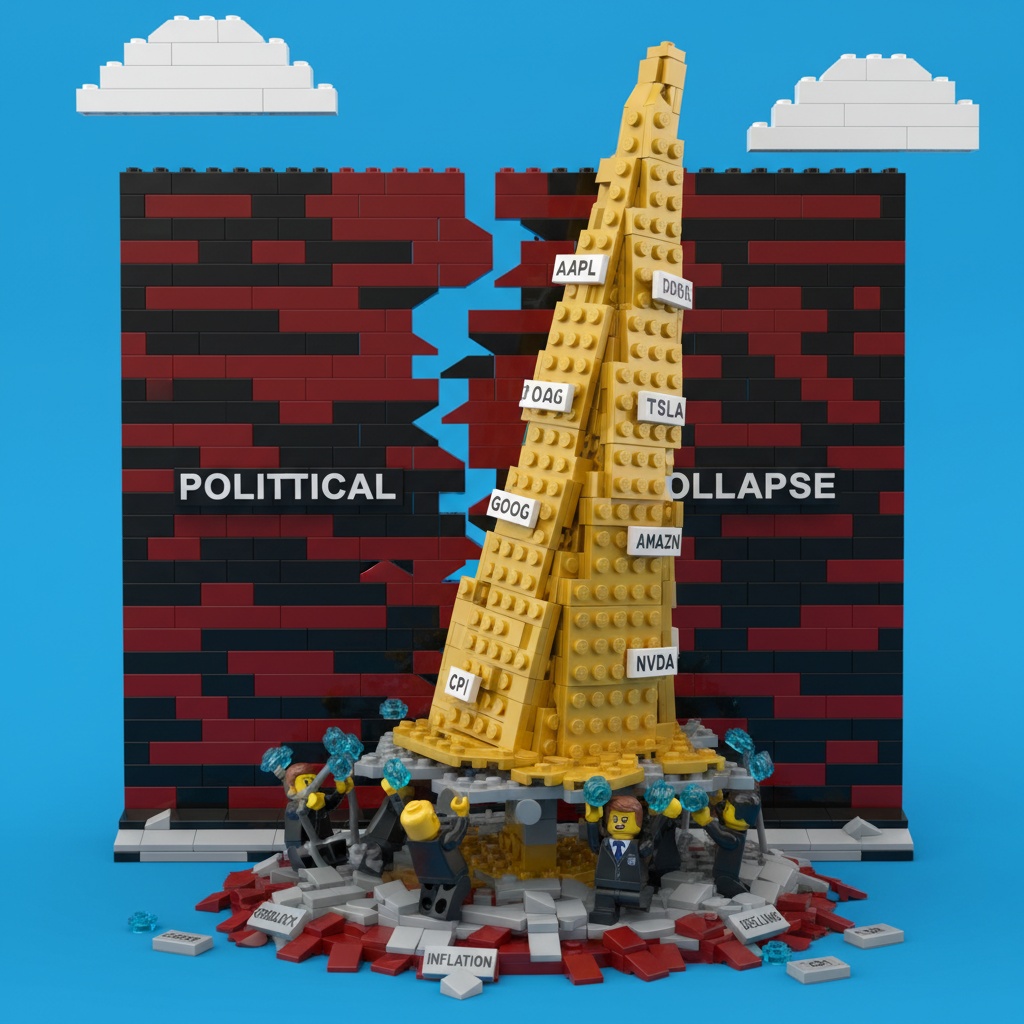
The Valuation Paradox: Why Markets Ignore Political Collapse
Why are US stocks hitting record highs while geopolitical risks and domestic gridlock escalate?
Key Takeaways
The CPI relief rally is masking a deeper valuation problem: major stocks trade at 25x 2025 earnings despite being highly capital-intensive and debt-heavy.
The US military buildup off Venezuela is not primarily counter-narcotics; analysts confirm it's a massive deployment intended to force regime change on Nicolás Maduro.
The government shutdown's human cost is immediate: a food bank CEO stated they cannot possibly make up the $44 million SNAP budget shortfall in Central Texas alone.
Digest Info

The CPI Relief Rally: Is the Market Too Optimistic?
The Dow hit a record high close above 47,000 following a softer-than-expected CPI print, fueling hopes for continued Fed rate cuts. Traders believe the strong earnings season, showing 10.2% EPS growth, provides a 'green light' for the rally, despite lingering skepticism.
“The Dow nearly 500 points for its first ever close above 47,000.”
Live from the NASDAQ market site in the heart of New York City's Times Square on a record-breaking day where the Dow closed above 47,000 for the first time.
This is Fast Money.
Here's what's on tap tonight.
A record rally.
Major indices all notching all-time closes today.
The headlines driving the gains and whether there's more upside to come.
And big tech on deck.
More than $15 trillion worth of companies reporting earnings next week.
Will the numbers keep the trade in rally mode?
We'll debate that.
Plus, nuclear gains for uranium stocks, shares of HokaMaker, Decker's run out of steam and zooming higher.
Why the chart master says now is the time to buy the one-time work-from-home darling.
I'm Melissa Lee coming to you live from Studio B at the Nasdaq.
On the desk tonight, Tim Seymour, Karen Feinerman, Courtney Garcia.
and Carter Braxton Worth.
We start off with the sound of records being broken across Wall Street.
The Dow nearly 500 points for its first ever close above 47,000.
The S&P breaching the 6,800 level and the Nasdaq leading the gains, jumping more than 1%.
Small caps not sitting out this rally, though the Russell 2000 fell just short of its own record.
It notched its best week since August.
Today's moves come after a slightly softer than expected CPI print, the only official economic data released since the government shutdown at the start of the month.
Consumer prices rising three-tenths of a percent in September versus the prior month and three percent from the year before.
That boosted hopes that the Federal Reserve can stay on its rate-cutting path at next week's meeting.
All this ahead of the busiest week of earnings season with nearly 100%.
A third of the S&P 500 and more than a third of the Dow Center deliver results.
Five of the MAG7 stocks are headlining the action.
Alphabet, Meta, Microsoft, Amazon and Apple all on the calendar.
So the Fed decision looming, a slew of mega cap results to come.
What's today's strength tell you?
Tim, it tells me that we have a green light to at least the best month of the year from the Fed's perspective, from the earnings season's perspective.
Folks falling at home.
I mean, we talk about this every night.
It's been a very solid earnings season and we have next week is kind of the week and then a couple after that.
But, you know, we're 10.2 percent EPS growth, which is better than expected coming in.
So when you combine that with the rest of the macro that we do get that's either not really the usual data we're getting from the government, but I think you have a great backdrop of you're hearing from companies how resilient their earnings profile is.
You are hearing from the top down that
Most people don't even really know what owner's equivalent rent is.
All you need to know is that this is the best sign we've seen in owner's equivalent rent for an overall CPI number in months.
So it was a relief, especially when so much focus was on the CPI, given it is the only data point seemingly.
that the Fed has that's somewhat coincident, although it's backward-looking.
So, look, I think this is a great backdrop.
I think we've had some of the froth taking out of markets.
I think there's a lot of skepticism out there.
And in some sense, I really still think the pain trade is higher.

Political Gridlock: The Cost of Missed Paychecks and Blame Games
Congressional reporter Sam Greenglass details the lack of progress in the federal government shutdown, where hundreds of thousands of workers missed paychecks. The impasse centers on Democrats demanding an extension of Affordable Care Act subsidies, while Republicans push for funding only essential workers, turning the crisis into a partisan blame game.
“They're barely even talking, even as hundreds of thousands of federal workers missed a paycheck on Friday.”
In Washington, Democrats and Republicans have made no progress toward ending the federal government shutdown.
They're barely even talking, even as hundreds of thousands of federal workers missed a paycheck on Friday.
Over the weekend, a pop-up window on the official USDA site said food stamp benefits will run dry on November 1st.
The site, which is funded by the taxpayers, repeated partisan Republican talking points blaming Democrats for the shutdown.
NPR congressional reporter Sam Greenglass is covering...
Nothing that's happening to end this shutdown, although there are various efforts.
Sam, good morning.
Hey there.
Okay, so would we expect that federal workers will go unpaid until the shutdown ends, given that the Senate has turned aside a couple of efforts to change that?
Well...
That is possible, but the Senate could try again this week.
But Republicans want a measure to pay only employees working without pay, like TSA agents.
Democrats want to get a paycheck to all federal employees and also block the White House from doing more layoffs.
That last part is going to be a non-starter for a lot of Republicans, though Republican Senator Ron Johnson did say he's open to something more inclusive.
My bill is obviously targeted to the people we're forcing to work.
But I'm not necessarily opposed to paying for the workers as well.
That's something we can talk about, OK?
Democrats say only paying workers who are considered essential basically lets the White House decide who gets paid and who doesn't.
And they're already doing that to some extent, like repurposing funds to pay active duty military.
Does any of this amount to progress toward actually running the government in a normal way?
So these bills allowed both parties to say the other blocked pay for federal employees.
I mean, you had Republicans calling their measure the Shutdown Fairness Act and Democrats naming theirs the True Shutdown Fairness Act.
And that kind of blame game has really been a refrain throughout this shutdown without much movement, though it was notable that three Democrats voted for the Republican bill to pay some workers, including Senator John Ossoff of Georgia, who's the only incumbent Democrat up for reelection in a state Trump won.
Interesting that some people are thinking about their reelections, perhaps.
But is anything here likely to disrupt the impasse?
I've heard some Republicans predict Thanksgiving will be a turning point.
When Transportation Secretary Sean Duffy spoke alongside House Republicans last week, he talked a lot about air traffic controllers working without pay.
We are all about safety.
But again, I can't guarantee you that your flight's going to be on time.
I can't guarantee you that your flight's not going to be canceled.
We've also heard many states announce they're going to run out of money next week for food assistance benefits known as SNAP.
I guess we should note, frequently when there's a government shutdown, the parties are reversed.
It is the Democrats saying, come on, just open the government and we'll negotiate, and it's Republicans making demands.
This time it's Democrats making a demand and Republicans saying no to the whole thing.
What makes Democrats think Republicans would change course?
So just to remember, Democrats have been holding out on supporting a funding bill until Republicans agree to extend expiring health insurance subsidies.
Democrats think that expiration date is going to be harder to brush aside after this week when open enrollment begins for plans through the Affordable Care Act marketplace.
and many Americans could see their premiums soar.
Still, some Democrats say President Trump needs to get involved to break this stalemate, but he is in Asia this week, so that is not going to happen anytime soon.
NPR congressional reporter Sam Greenglass, thanks so much.
The SNAP Crisis: Why Food Banks Can't Bridge the Gap
Congressman August Pfluger highlights the extreme worry over food assistance programs (SNAP) running out of money. The CEO of the Central Texas Food Bank confirms the crisis, stating they cannot possibly make up for a $44 million food budget shortfall, emphasizing the immediate need for the government to reopen.
“I think the food assistance is one that I would put at the very highest level of worry.”
NPR congressional correspondent Barbara Sprunt went to Texas to see what one of those lawmakers has been hearing.
Barbara joins us now.
Thanks for being with us.
Thanks for having me.
I gather you visited Lano, about 90 minutes northwest of Austin.
It's represented by Congressman August Pfluger.
What did he say to constituents?
Well, he praised Republicans' signature tax and spending bill from earlier this year.
It included tax cuts and changes to the Medicaid program.
all very popular with this group of about 40 people, including some members of local government.
That wasn't a surprise to me.
This district went for President Trump in 2024 by 72%.
It is a solid red district.
He also talked a lot about the shutdown.
He said the House did its job in passing a continuing resolution to temporarily fund the government just before they left in mid-September.
But the House still hasn't returned.
That's right.
For now, the speaker isn't bringing the chamber back until Senate Democrats agree to fund the government.
And the congressman laid out why he thinks Democrats haven't done that yet.
Pfluger said Senate Minority Leader Chuck Schumer needs to look like he's opposing President Trump at every turn.
I think he has to look tough to his radical left base because he's worried about AOC being the next senator from New York.
And so he has to be seen as fighting Trump.
Of course, Senate Democrats would put it a bit differently.
They say they're trying to force a negotiation on extending ACA subsidies that are set to expire at the end of the year.
Pfluger, like his party leadership, says they should fund the government first and then negotiate on the subsidies.
So I asked voters at this about the town hall.
Carlton Johnson, a Republican, said he has big concerns about health care, but Democrats' message just doesn't resonate with him.
What I see is the Democrats trying to hold the country hostage to get what they want.
Yeah, I think it's very childish.
Of course, health care is at the center of why the shutdown continues.
More and more states will be feeling the consequences, particularly cuts to nutrition assistance.
Did that come up?
It did.
Here's the congressman.
I think the food assistance is one that I would put at the very highest level of worry.
Can you imagine kids not getting the funding they need?
Now in Texas, over 3 million people use SNAP benefits, and about 10% of households in Pfluger's district, according to an estimate from the U.S.
Census.
One constituent told me she's very concerned about kids not getting this assistance, but she hopes that food banks can step up.
Is that even possible?
Well, I called the CEO of the Central Texas Food Bank to ask exactly that question.
Here's Sari Vatsky.
There is no way that we alone can make up for a $44 million food budget shortfall.
We are currently spending $1.3 million per month, which is already up from $1.1 million to purchase food to make up for the increased need.
So
Simply put, we need the government to reopen.
She said that if November SNAP benefits are gone for families in Central Texas, what that means is 127,000 households without those benefits.
Of course, President Trump hasn't stepped forward to try to broker a deal.
What did people there have to say about his involvement?
Well, you know, a few people mentioned wanting to see him step in and play a role.
Small business owner Mickey Kosarek is particularly concerned about these health care premiums skyrocketing without an extension of the subsidies.
And he said he wonders where the president is in all of this.
I mean, he wrote the heart of the deal, right?
You know, if he's such a good negotiator and does that, why didn't he say, let's sit down, let's find something?
He's a Republican, but he's critical of the president.
He says that if Trump stepped in to stop the shutdown, it would be a plus in his book.
But the president left for a trip to Asia yesterday, so it's looking unlikely that he'll be sitting down at any negotiating table with Democrats and Republicans anytime soon.
And Paris Barber Sprunt, thanks so much.
US Aircraft Carrier Rerouted: Counter-Narcotics or Regime Change?
The U.S. has rerouted the world's largest aircraft carrier, the USS Gerald R. Ford, carrying 5,000 personnel, to the Caribbean off Venezuela's coast. While the administration cites counter-narcotics, Senator Lindsey Graham explicitly stated the campaign's intention is to oust authoritarian leader Nicolás Maduro, raising questions about the legality and excessive force (missiles vs. speedboats).
“He has all the authority in the world. This is not murder. This is protecting America from being poisoned by narco-terrorists coming from Venezuela and Colombia.”
The massive military buildup in the Caribbean waters of Venezuela is causing some concern from Caracas to the U.S.
Congress.
Democratic lawmakers and some Republicans are questioning the Trump administration's military campaign there.
In the past month, military strikes on suspected drug boats have killed at least 43 people.
Meanwhile, Venezuela's military spent the weekend preparing for land strikes.
Let's pick up the conversation right there with NPR's South America correspondent, Kerry Kahn.
Kerry, good morning.
Good morning, Steve.
What does that mean for Venezuela to prepare for land strikes?
They held military exercises along the country's Caribbean coast, and these were on heavy repeat on state TV.
To call them military exercises, it was a very minimal show of force, not a lot of hardware, mostly a few dozen troops running on the beach.
Minister of Defense Diosdado Cabello said what Venezuela lacked in firepower, however, it made up in determination.
But also to protect ourselves from drug trafficking, to protect ourselves from the threats
He says the military is also there to protect Venezuela from drug traffickers.
He's just denying U.S.
charges that it leads a narco drug organization.
The U.S., as he said, isn't backing down.
It has rerouted the world's largest aircraft carrier, the USS Gerald R. Ford, to the region.
And they have about 5,000 personnel on board.
That's to add to the nearly 10%.
10,000 fighters and sailors that are already there in the region.
Now, given that legal experts have questioned the U.S.
authority for blowing up boats in the Caribbean, much less invading another country, how is the administration addressing the legality of all this?
The administration says it has the authority.
And Republican Senator Lindsey Graham, speaking on CBS yesterday, reiterated that position.
He says Trump has the power to launch the strikes.
He has all the authority in the world.
This is not murder.
This is protecting America from being poisoned by narco-terrorists coming from Venezuela and Colombia.
Graham also says there's a real possibility, that's what he said, the military campaign will expand to land strikes soon.
Drug interdiction in the Caribbean has long been done by the U.S.
Coast Guard, and many in Congress and beyond are saying using missiles and destroyers to blow up speedboats is excessive, not to mention overly expensive.
Graham clearly said yesterday the U.S.
intention is to oust Venezuela's authoritarian leader, Nicolás Maduro, from power.
The U.S.
has also talked tough about Colombia, Venezuela's neighbor.
What's going on there?
Sure.
Secretary of State Marco Rubio yesterday spoke to reporters en route to Doha, and he repeated tough rhetoric toward Colombia's President Gustavo Petro as well.
The U.S.
just sanctioned Petro and his family.
Rubio has called Petro a lunatic and accuses him of also aiding drug trafficking.
That's all the while the U.S.
has cut counter-narcotic aid there.
I've got to ask about one other thing.
Brazil's president has gone back and forth with the U.S.
president, and then apparently they met yesterday in Asia?
Yes.
Trump and President Luiz Inácio Lula da Silva did finally talk trade yesterday in Asia.
Trump slapped 50 percent tariffs on Brazilian goods, complaining that Brazil unfairly prosecuted its former far-right leader, convicting him of attempting a coup.
Lula is the leading leftist in the region, and now he's floating the idea of mediating talks between the U.S.
and Venezuela.
Back to our original story.
Carrie, thanks so much.
You're welcome.
Tomahawk Missiles vs. Speedboats: The True Intent of the Buildup
Analyst Eder Peralta confirms that the deployment of the USS Gerald R. Ford and guided missile destroyers is an escalation of the standoff with Venezuela, not a counter-narcotics operation. He notes that the DEA's own data shows little drug transit through Venezuela, concluding that the military gear is intended to topple or put fear into the Maduro government. Venezuelan citizens express a mix of fear and hope for military intervention.
“You don't need Tomahawk missiles to deal with speed boats in the Caribbean.”
NPR's Eder Peralta just came back from a reporting trip to the Caribbean, and he joins us now from his base in Mexico City.
Good morning, Eder.
Hey, good morning, Aisha.
So what's the latest?
Like what kind of military presence will the U.S.
have in the Caribbean?
I mean, look, the big news is that Secretary of Defense Pete Hegseth has rerouted the USS Gerald R. Ford from the Mediterranean to the Caribbean just off the coast of Venezuela.
The U.S.
military describes the USS Gerald Ford as, quote, the most capable and lethal naval mission package in the world.
It's massive.
I mean, it can carry anything.
up to 90 aircraft, and the strike group that comes with it is also significant.
It includes guided missile destroyers and up to 5,000 troops.
And the news here is that the aircraft carrier is joining an already robust deployment.
Remember, the U.S.
had already deployed a submarine, F-35 fighter jets, Reaper drones, surveillance aircraft, and 10,000 troops.
Um, it has been decades since the U S has deployed this heavily in the Americas.
And so far the U S has targeted 10 small vessels that they allege were carrying drugs.
Uh, the U S says it has killed at least 43 people.
The U S says this is a counter narcotics operation.
Is there evidence of that being true?
I mean, look, uh, what every analyst I've spoken to has told me is you don't need Tomahawk missiles to deal with speed boats in the Caribbean.
Uh,
We also have to point out the obvious.
By the DEA's own accounting, very little of the drugs that come into the United States actually transit through the Caribbean or Venezuela.
What's clear is that all of this military gear is very capable of either directly toppling the government of President Nicolás Maduro in Venezuela, or at least putting some fear into the government to force Maduro out of power.
And I think the Trump administration itself has already telegraphed
what this massive deployment is really about.
They have said that this is an operation against Tren de Aragua, which is a Venezuelan gang that the US has designated as a, quote, narco-terrorist organization.
And then Secretary of State Marco Rubio said that President Maduro is the head of that organization.
Finally, President Trump has on multiple occasions said the US has now controlled the waters and that it may very well go after targets on land.
What are you hearing from Venezuela?
What's the government and what are the people there saying?
President Nicolas Maduro has kind of been vacillating between trying to show strength.
You know, he deployed troops to the Caribbean and state TV has been showing off Venezuela's military hardware.
But at the same time, Maduro has been trying to bring the temperature down.
In one of his recent speeches, he made it very clear he wanted peace and he did it in English.
Not warm, not warm.
Just peace, just peace, just peace forever, forever, forever.
Peace forever.
One of our producers went out to the streets of Caracas and she found a little bit of everything.
She found disinterest and worry and hope.
She spoke to a 53-year-old professor.
We're not using her name because she fears retaliation from the government.
And she said she so desperately wants a change in Venezuela that she welcomes American military action.
But she also said the uncertainty was eating at her.
We have fear on one side, she said, and hope on the other.
But we can't be certain about what's about to happen, she says.
That's NPR's Ader Peralta reporting from Mexico City.
Ader, thank you so much.
Trump’s Asia Trip: Pressuring Allies and the Isolationist Threat
President Trump’s Asia trip focuses heavily on bilateral meetings, contrasting with the region's desire for multilateral integration and free trade. Allies like Japan and South Korea are pressured to pledge nearly $1 trillion in investment and pay more for military protection, aggravating fears that the US will either drag them into conflicts or become isolationist and abandon them.
“The U.S. seems to be focused on great power competition and trade protectionism.”
And Paris Anthony Kuhn joins us from South Korea, the president's final stop.
Anthony, thanks for being with us.
My pleasure, Scott.
Give us a sense of what's on the agenda.
Well, President Trump's itinerary centers on two summits, the Association of Southeast Asian Nations in Malaysia and the Asia-Pacific Economic Cooperation in South Korea.
But President Trump is more focused on bilateral meetings.
And there's some criticism in the region that ASEAN and APEC are multilateral forums.
They're promoting regional integration and free trade, while the U.S.
seems to be focused on great power competition and trade protectionism.
President Trump wants to preside over a Thai-Cambodian ceasefire deal, apparently to burnish his peacemaker image, which has led to some criticism in the region that Trump is more focused on himself than Southeast Asia.
There's certainly no shortage of conflicts that he could try to end, such as Myanmar's brutal civil war, but he doesn't seem interested in that one.
President is expected to meet, as we mentioned, his Chinese counterpart.
How do you believe he'll handle that meeting?
Well, it's tough.
Trade tensions have flared and both sides are trying to pressure the other one with tariffs and export controls.
U.S.
and Chinese trade officials are meeting in Kuala Lumpur to try to de-escalate that.
If the talks fall through, a Xi Jinping-Trump meeting might not even happen and the Chinese side has not confirmed that there will be this meeting.
I spoke to Zhu Feng, who is dean of the School of International Studies at Nanjing University.
Here's what he told me.
If the negotiations in Malaysia get no results, he told me, then the resulting US-China split will be very worrying.
He adds that China has already endured unendurable treatment from the US, and it's got to push back to show that it will not be cornered by the US.
President Trump is also known for his skepticism toward allies as well.
What can we expect from meetings with countries that include Japan and South Korea?
Well, President Trump will meet in Japan with the country's new female prime minister, Sanae Takeuchi, and in South Korea with President Lee Jae-myung.
And the U.S.
has gotten both of these allies to pledge a combined nearly $1 trillion in investment in the U.S.
in exchange for lower tariffs.
But there are still differences, such as how much of that is paid up front in cash.
And if the allies aren't happy with the details, they could try to negotiate.
If the U.S.
isn't happy with that, it could reimpose tariffs.
Both Seoul and Tokyo are under pressure from the U.S.
to pay more for military protection and to help the U.S.
confront China.
President Trump said on the way to Malaysia that he is open to meeting with North Korea's leader Kim Jong-un, but apparently there are no plans for that to happen so far.
This is President Trump's first trip to Asia in his second term.
Anthony, what can we say about President Trump's Asia policy?
Well, previous administrations, especially President Obama's, have said they want to try to pivot to focus their attention on Asia.
Trump has not.
He has been mostly focused on conflicts in Europe and the Middle East.
There is a central disagreement within the administration between maintaining U.S.
primacy in Asia or putting America first by minding its own hemisphere.
And that has aggravated fears among many nations that the U.S.
will either drag its allies into unnecessary conflicts or become isolationist and just abandon them.
And here's Anthony Kuhn joining us from Seoul, South Korea.
Anthony, thanks so much.
China's Rare Earths Leverage and the Taiwan Concession
The US and China reached a 'framework' for a trade deal during Trump's Asia trip, but this is merely an agenda, not a final agreement. China appears willing to delay export licensing restrictions on rare earth minerals for a year, maintaining leverage. Hawks worry Trump might compromise U.S. national security by softening the stance on Taiwan or allowing China to buy more advanced semiconductor chips in exchange for a 'splashy deal.'
“A framework is not a final deal. A framework is an agenda.”
Treasury Secretary Scott Besson said the U.S.
and China had reached a framework for a trade deal with China.
But, Mara, what does that mean?
Well, a framework is not a final deal.
A framework is an agenda.
And sometimes the final deals don't pan out either.
Certainly in his first term, Trump was disappointed that China didn't agree.
didn't carry out the trade deal he made with them.
But what Scott Besson said yesterday on ABC is he expects the Chinese to delay for a year those export licensing restrictions on rare earth minerals.
And in exchange, Donald Trump would not slap the 100% tariffs that he's threatened.
But the Chinese readout of that meeting between U.S.
and Chinese trade officials did not mention these terms.
So we're going to have to wait to see what happens.
Now, on the plane to Asia, President Trump told reporters, he said, China will have to make concessions and we will too.
So the big question is, which concessions will Trump make?
Will he let China buy more advanced semiconductor chips?
Some national security experts say that would be dangerous.
Would he soften the U.S.
stance toward Taiwan and say the U.S.
opposes Taiwanese independence?
That's something China would like.
Yesterday he was asked about that.
He didn't want to discuss Taiwan.
He has held up a $400 million arms package for Taiwan.
And hawks in the Republican Party are worried that Trump is so eager for a big, splashy deal that he might compromise U.S.
national security interests along the way.
I'm interested in all the details you give me, Mara, especially about Rare Earths saying that China would...
extend for a year this cutting off of, or rather delay for a year this cutting off of rare earth minerals, which means China would still have leverage as they continue further talks.
How does this make things different than perhaps they've been in the past between the U.S.
and China?
Well, China, as Trump might say, has a lot of cards.
And they've been playing them.
They haven't bought soybeans from U.S.
farmers.
As you said, they've held up these rare earth exports.
And China is a big, powerful country.
In many ways, it's as strong as the U.S.
It's soon to be the biggest economy in the world.
And this is a very different power dynamic.
Trump can't just unilaterally lay down the terms of a trade deal the way he has done with smaller, less powerful countries.
This is very interesting because it brings to mind Trump's dance, if that's the right word, over time with Russian President Vladimir Putin.
That's true.
In many ways, his talks with Xi have been similar to these on-again, off-again talks with Putin.
Lots of whiplash.
He was going to meet with Putin.
Now he's not.
He threatened tariffs against China.
Now he's not.
He threatened to cancel this meeting with Xi, but he clearly backed off of that.
So I think there are a lot of theatrics to this.
Tariff Shock: Deckers Plunges as Consumer Spending Softens
Deckers Outdoor Corporation (Hoka sneakers, Ugg boots) stock plunged 15% after cutting its full-year sales forecast, specifically citing that price increases due to tariffs are impacting customer purchases. Analysts view this as a warning sign for the entire consumer discretionary sector, suggesting consumers have 'one too many pairs' of such items.
“They said specifically that the price increases due to tariffs, that they are impacting customer purchases at this point.”
Coming up, Decker's hits the deck.
The numbers out of the shoemaker's earnings that had investors giving the stock the boot.
The chart master says this one time market favor could be about to zoom higher.
He is talking technicals right after this.
This is Fast Money with Melissa Lee.
right here on CNBC.
Welcome back to past when you get a buzzkill on Decker's Outdoors, a maker of Hoka sneakers and Ugg boots, sinking 15 percent today after cutting its full year sales forecast due to tariff concerns.
The company now expects revenues of five point three five billion this year versus estimates of five point four five billion.
The stock is down nearly 60 percent year to date, hit two year lows during the session.
They said specifically that the price increases due to tariffs, that they are impacting customer purchases at this point.
Yeah, although one thing I found interesting was the Uggs versus the Hoka, I'm sorry, versus the Hoka, and expectations were the other way around.
Uggs would be softer, Hoka would be better.
I actually think the read-through might be a positive for Nike, and Nike, we know, has really tried to
Aside from fixing the DTC, which was way too aggressive, getting back into wholesale, but also taking on On and Hoka and others.
So I actually thought this was positive for Nike.
We saw that On was down as well.
I don't know if that's similar.
They also have that same same supply chain issue.
I think I like Nike out of this.
My read of the whole thing.
I think it's a combination of there's bad macro and I think there's bad bottom up for these guys.
And I just think the chart, I mean, I'll let the master talk about it in a second, but I think you've got a dynamic here where this has been, this is exactly what I would have expected from these numbers.
I'm not trying to sound like Monday morning quarterback, but I've been looking at deckers.
I've been looking at a handful of these, let's call them discretionary retail apparel names, Burke, you name it, on, on.
I think they're all
under pressure here, and I think we have one too many pairs of those things in our closet.
I don't have any pairs of those things.
But this is the way you started.
Think of the two things you said.
You said it was down 60% for the year and making two a year.
That tells the whole story.
Weakness begets weakness.
Often that's the nature of momentum, right?
There's positive and negative momentum.
This has bearish momentum.
It's out of the last four quarters, three, it has dropped and gapped 15% or more.
Wow.
Something's wrong.
Was there a bounce right after?
I mean, is there like a quick trade here?
No.
It goes down to that, finds that new level and wallows there before it finds the next level.
Oh, that sounds pretty dismal, Court.
What do you think?
Yeah, I agree.
I think the first thing that came to my mind was what does this mean for Nike?
Which, I mean, their biggest concern right now is their competition, Hoka being one of those.
And I can kind of see this going either way for them, right?
Because you are seeing that demand toward HOKAs.
That actually was a bright spot here.
But on the flip side, are you seeing more market share in the HOKAs and less toward Nike?
And I don't think we're going to know that yet.
But I think how this actually plays out to them is the question.
Is this consumer trends or is this tariffs?
The 25x Earnings Paradox and the Bullish Oil Bet
Peter Bookvar, CIO at OnePoint BFG Wealth Partners, warns that the market is trading at 25 times 2025 earnings estimates. He highlights the paradox of major tech companies now being highly capital-intensive with high debt, yet still valued like asset-light, cash-generative businesses. Bookvar recommends energy, calling oil 'dirt cheap' due to sanctions and OPEC production failures, and consumer staples as a safety port.
“We're trading at 25 times [2025 earnings estimates]. And Tim mentioned valuations don't matter. They don't matter until they do.”
Let's get some more on the markets and the reaction to CPI today.
Let's bring in CNBC contributor Peter Bookvar, chief investment officer at OnePoint BFG Wealth Partners.
Peter, great to have you with us.
I just want to sort of fold you into this conversation that we're having.
The CPI gives us a green light to think that there's two more cuts, but at the same time, we are at record highs across the board, entering a huge earnings season.
What's your view of the markets and how we are valued right now?
Well, now, relative to 2025 earnings estimates, obviously, we have more to come with Q4 after Q3.
We're trading at 25 times.
And Tim mentioned valuations don't matter.
They don't matter until they do.
And I'm not sure when they will.
With those big names that we're going to see earnings next week, the interesting thing that I find is that now that they've all turned themselves into highly capital-intensive businesses,
with much higher debt levels, much less cash flow, the market is still valuing them at the same multiples as they were when they were asset light and very cash generative.
Now, that can continue.
But I think that that's something that investors should think about, particularly when they digest next week's earnings, particularly the CapEx levels relative to revenue that are now at extraordinary levels.
It is amazing to think that you have gone from a picture where you rewarded the companies for not spending all that, being asset light, to now being asset heavy because they are spending on all this hardware, et cetera, and expending all this capex and still getting the same valuation.
I mean, it just sort of turns it all on your head.
In terms of where you see value in the markets, though, you do like energy at this point?
I mean, you think that that's a place where you can still see some gains?
I love oil prices here.
I think they're dirt cheap.
I think the catalyst this week with the sanctions on Rosneft and Lukoil, in addition to India and China related to the sanctions
buying less oil, I think is a major catalyst.
And even going into this, I've been thinking that we are setting up ourselves for a rally.
That has to do with US shale that is no longer a major contributor to global oil supply.
That is OPEC production, which is not keeping up with quotas.
The whole world is bearish on oil.
Every day, I hear about us swimming in it.
But I think $60 is dirt cheap.
The other area that I love that's been thrown out the window this year are the consumer staple stocks, which are now trading like bonds with 4%, 5% dividend yields, cheap valuations.
And if the economy does continue to slow, I think this could be a port of safety for investors.
About this digest
Release notes
We remix the strongest podcast storytelling into a tight, twice-weekly digest. These notes highlight when this edition shipped and how to reference it.
- Published
- 10/28/2025
- Last updated
- 10/28/2025
- Category
- news
- Chapters
- 9
- Total listening time
- 30 minutes
- Keywords
- global instability: political gridlock, geopolitical tensions, and macroeconomic response